
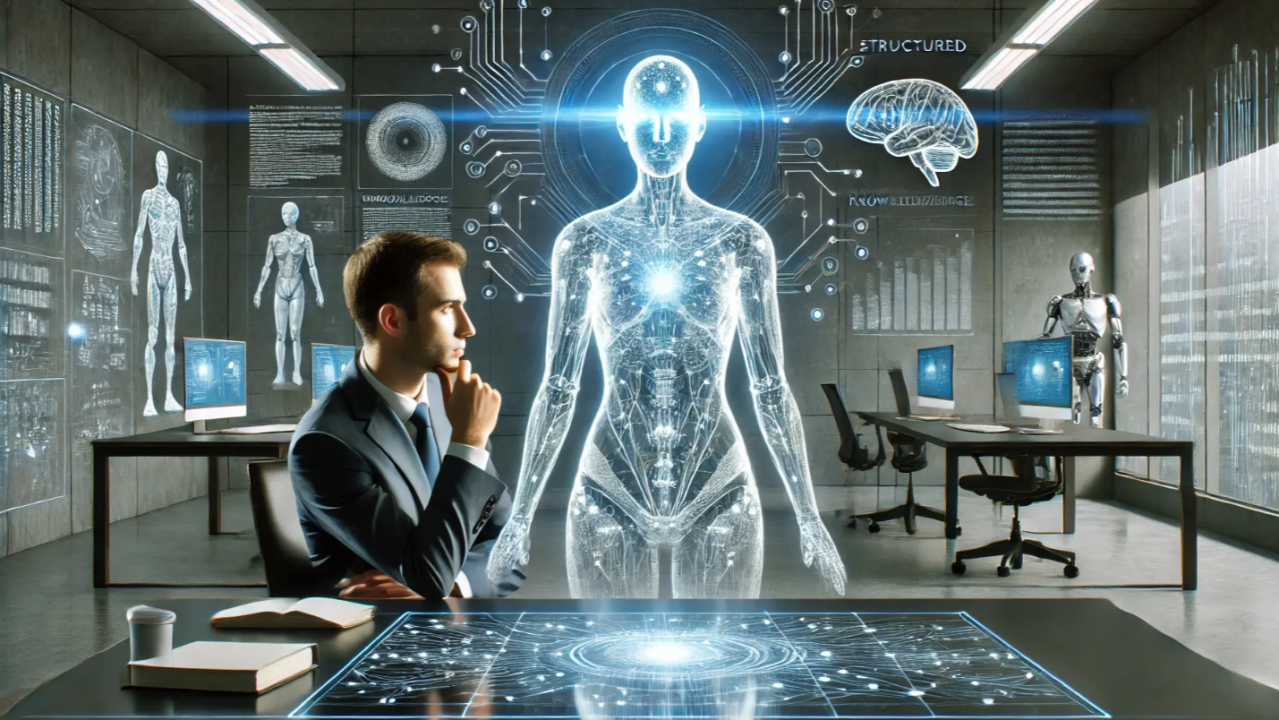
The landscape of work is undergoing a profound transformation, driven by advancements in artificial intelligence. What was once the domain of science fiction, the concept of a digital
LOADING...
Contacting Nonilion systems...
Learn Munder Difflin – Agent harness to run an office of your clones with practical strategies, examples, and expert guidance.
Learn Munder Difflin – Agent harness to run an office of your clones with practical strategies, examples, and expert guidance.
The landscape of work is undergoing a profound transformation, driven by advancements in artificial intelligence. What was once the domain of science fiction, the concept of a digital
The landscape of work is undergoing a profound transformation, driven by advancements in artificial intelligence. What was once the domain of science fiction, the concept of a digital
workforce is rapidly becoming a practical reality. Tools that can coordinate multiple AI agents are no longer experimental curiosities; they are emerging as a new layer of software for knowledge work.
Most AI tools today are built around a single prompt, a single response, and a single user. That works well for isolated tasks, but real office work is rarely isolated. A product launch, customer research project, or internal policy update usually involves several steps, multiple sources of information, and coordination across different roles.
Munder Difflin is designed around that reality. Instead of asking one model to do everything in one shot, it provides an agent harness that can run an “office” of specialized clones. Each clone can take on a role such as researcher, writer, reviewer, planner, or analyst, and the harness manages how they interact. The result is less like chatting with a chatbot and more like directing a small distributed team.
This shift matters because it changes the unit of automation. Rather than automating a sentence, Munder Difflin aims to automate a workflow.
The phrase “office of your clones” captures the core idea well. In a traditional office, different people bring different strengths and responsibilities. A researcher gathers facts, a strategist interprets them, a copywriter turns them into language, and an editor checks quality. Munder Difflin mirrors that structure with AI agents that can be assigned distinct identities and tasks.
That division of labor has several advantages:
This is especially useful when the work requires both creativity and rigor. A single model may generate a polished answer, but a multi-agent setup can separate ideation from verification, which often leads to more reliable results.
An agent harness is the orchestration layer that coordinates the behavior of multiple AI agents. It handles the practical details that make multi-agent systems usable: task assignment, message passing, state management, retries, and termination conditions.
In a system like Munder Difflin, the harness may define:
Without a harness, multiple agents can quickly become chaotic. They may duplicate work, contradict each other, or wander off topic. The harness keeps the office productive by imposing structure, much like a manager or project coordinator would in a human team.
Imagine a company needs to update its remote work policy. This sounds simple, but the process can involve legal review, HR alignment, tone calibration, and communication planning.
A Munder Difflin-style workflow could look like this:
Instead of one model trying to juggle all of those concerns at once, the harness lets each clone focus on its lane. That makes the process more modular and easier to improve over time.
A single AI assistant often feels like a very smart autocomplete. A multi-agent harness feels more like a process engine. The difference is subtle at first, but it becomes obvious when the task grows in complexity.
With one agent, users tend to ask for a final answer. With several agents, users can ask for a workflow outcome. That might mean:
This approach is closer to how organizations actually work. Most business problems are not “answer this question” problems; they are “move this work forward” problems.
The idea of clones is not about replacing people one-to-one. It is about replicating useful working patterns. In a knowledge job, much of the effort goes into switching contexts: reading, summarizing, comparing, rewriting, checking, and coordinating. Clones can absorb some of that load.
For example, a marketing team could use clones to:
A product team could use them to:
A support team could use them to:
In each case, the harness turns a pile of fragmented tasks into a coordinated system.
Even in a clone-based office, humans remain essential. The best use of Munder Difflin is not to remove people from the loop, but to move them to higher-leverage decisions.
Humans are still needed for:
That distinction is important. AI agents can accelerate execution, but they do not automatically understand organizational nuance, ethics, or strategic intent. A good harness should make human oversight easier, not harder.
Once multiple agents are involved, quality control becomes critical. One weak agent can contaminate the whole workflow if there are no safeguards. That is why a robust harness needs guardrails.
Useful guardrails include:
These controls help prevent the office of clones from becoming an office of confident mistakes. They also make the system easier to trust in real operational settings.
A major strength of a harness is the ability to let agents collaborate rather than simply work in parallel. Collaboration means one agent can build on another’s output, challenge assumptions, or request clarification.
Some useful interaction patterns include:
This is where the “office” metaphor becomes especially powerful. Teams are not just collections of workers; they are systems of communication. Munder Difflin’s value lies in making those communications programmable.
As promising as this is, there is a real risk of over-automating work that should remain human-centered. Not every process benefits from being split into clones. In some cases, the overhead of orchestration can outweigh the gains.
Potential pitfalls include:
The lesson is not to automate everything, but to automate selectively. The best candidates are repeatable, multi-step tasks with clear success criteria and enough volume to justify the setup.
The quality of a multi-agent system depends heavily on role design. If every clone has the same vague instructions, the system will produce vague results. Effective roles should be narrow, meaningful, and complementary.
For instance, instead of creating three generic “AI assistants,” a workflow might define:
Each role should have a clear purpose and a clear handoff. The more distinct the roles, the easier it is for the harness to coordinate them.
Traditional prompting asks, “What should the model say?” Orchestration asks, “What system should produce the outcome?”
That is a significant evolution. It shifts the focus from isolated language generation to end-to-end task completion. In practice, this means users spend less time crafting perfect prompts and more time defining workflows, rules, and success criteria.
This is where Munder Difflin fits into the broader future of AI tooling. The next wave of productivity software may not be about better chat interfaces alone. It may be about systems that can reliably coordinate many specialized agents across a business process.
For teams, the implications are substantial. A small group with a well-designed agent harness can operate with the output capacity of a much larger team, especially for research-heavy or documentation-heavy work. That does not eliminate the need for people; it changes the shape of the team.
Teams may start to think in terms of:
In other words, management itself becomes partly computational.
Munder Difflin points toward a future where AI is not just a tool that answers questions, but a system that participates in work. The most interesting part of that future is not the novelty of clones, but the possibility of making knowledge work more structured, more scalable, and less dependent on manual coordination.
If done well, an agent harness can reduce busywork, improve consistency, and help teams move faster without sacrificing judgment. If done poorly, it can create noise, confusion, and false confidence. The difference will come down to design: clear roles, strong guardrails, and thoughtful human oversight.
The office of your clones is not a replacement for the office of people. It is a new operational layer for the kinds of work that people do best when they have help.
For Munder Difflin – Agent harness to run an office of your clones, Nonilion can be used as the practical AI-office example: a shared workspace where human teammates and AI agents keep discussion, decisions, and execution connected.
The reason Munder Difflin – Agent harness to run an office of your clones keeps returning to Nonilion is simple: the topic becomes more useful when it turns into coordinated work, not just another article, chat, or dashboard.
This trend matters to Nonilion because it points to a bigger change: teams are moving from simple calls toward persistent, AI-supported collaboration spaces. Nonilion can bridge live presence, meeting context, avatars, and follow-up work so the trend becomes a usable workflow instead of a headline.
Munder Difflin — Agent harness to run an office of your clones munderdiffl.in
chaitanyagiri/munder-difflin: local multi-agent harness github.com/chaitanyagiri/munder-difflin
You can now build yourself a clone to control your computer, if ... www.reddit.com/r/ClaudeAI/comments/1vo3sj9/you_can_now_build_yourse...
Someone basically built The Office… but every employee is ... www.instagram.com/reel/DcNjqnCOX39/
munder-difflin - AI Agents on GitHub | SkillsLLM skillsllm.com/skill/munder-difflin
Orchestrating Local Agents with Munder Difflin www.linkedin.com/posts/rahamanriaz_munder-difflin-make-clones-with-...
Munder Difflin Demo: open sourced local multi-agent harness www.youtube.com/watch
Meet Munder Difflin, a multi-agent harness. It helps you ... www.instagram.com/reel/DcNVenIEbUQ/
This article on Munder Difflin – Agent harness to run an office of your clones was generated by the Nonilion AI blog workflow using web research inputs and AI-assisted synthesis.
Questions / Answers
For Munder Difflin – Agent harness to run an office of your clones, Nonilion can help teams coordinate planning, meetings, and follow-ups in one collaborative workflow. It supports clearer decision tracking, async collaboration, and practical execution across distributed teams.
workforce is rapidly becoming a practical reality. Tools that can coordinate multiple AI agents are no longer experimental curiosities; they are emerging as a new layer of software for knowledge work.
Most AI tools today are built around a single prompt, a single response, and a single user. That works well for isolated tasks, but real office work is rarely isolated. A product launch, customer research project, or internal policy update usually involves several steps, multiple sources of information, and coordination across different roles.
Munder Difflin is designed around that reality. Instead of asking one model to do everything in one shot, it provides an agent harness that can run an “office” of specialized clones. Each clone can take on a role such as researcher, writer, reviewer, planner, or analyst, and the harness manages how they interact. The result is less like chatting with a chatbot and more like directing a small distributed team.
This shift matters because it changes the unit of automation. Rather than automating a sentence, Munder Difflin aims to automate a workflow.
The phrase “office of your clones” captures the core idea well. In a traditional office, different people bring different strengths and responsibilities. A researcher gathers facts, a strategist interprets them, a copywriter turns them into language, and an editor checks quality. Munder Difflin mirrors that structure with AI agents that can be assigned distinct identities and tasks.
That division of labor has several advantages:
This is especially useful when the work requires both creativity and rigor. A single model may generate a polished answer, but a multi-agent setup can separate ideation from verification, which often leads to more reliable results.
An agent harness is the orchestration layer that coordinates the behavior of multiple AI agents. It handles the practical details that make multi-agent systems usable: task assignment, message passing, state management, retries, and termination conditions.
In a system like Munder Difflin, the harness may define:
Without a harness, multiple agents can quickly become chaotic. They may duplicate work, contradict each other, or wander off topic. The harness keeps the office productive by imposing structure, much like a manager or project coordinator would in a human team.
Imagine a company needs to update its remote work policy. This sounds simple, but the process can involve legal review, HR alignment, tone calibration, and communication planning.
A Munder Difflin-style workflow could look like this:
Instead of one model trying to juggle all of those concerns at once, the harness lets each clone focus on its lane. That makes the process more modular and easier to improve over time.
A single AI assistant often feels like a very smart autocomplete. A multi-agent harness feels more like a process engine. The difference is subtle at first, but it becomes obvious when the task grows in complexity.
With one agent, users tend to ask for a final answer. With several agents, users can ask for a workflow outcome. That might mean:
This approach is closer to how organizations actually work. Most business problems are not “answer this question” problems; they are “move this work forward” problems.
The idea of clones is not about replacing people one-to-one. It is about replicating useful working patterns. In a knowledge job, much of the effort goes into switching contexts: reading, summarizing, comparing, rewriting, checking, and coordinating. Clones can absorb some of that load.
For example, a marketing team could use clones to:
A product team could use them to:
A support team could use them to:
In each case, the harness turns a pile of fragmented tasks into a coordinated system.
Even in a clone-based office, humans remain essential. The best use of Munder Difflin is not to remove people from the loop, but to move them to higher-leverage decisions.
Humans are still needed for:
That distinction is important. AI agents can accelerate execution, but they do not automatically understand organizational nuance, ethics, or strategic intent. A good harness should make human oversight easier, not harder.
Once multiple agents are involved, quality control becomes critical. One weak agent can contaminate the whole workflow if there are no safeguards. That is why a robust harness needs guardrails.
Useful guardrails include:
These controls help prevent the office of clones from becoming an office of confident mistakes. They also make the system easier to trust in real operational settings.
A major strength of a harness is the ability to let agents collaborate rather than simply work in parallel. Collaboration means one agent can build on another’s output, challenge assumptions, or request clarification.
Some useful interaction patterns include:
This is where the “office” metaphor becomes especially powerful. Teams are not just collections of workers; they are systems of communication. Munder Difflin’s value lies in making those communications programmable.
As promising as this is, there is a real risk of over-automating work that should remain human-centered. Not every process benefits from being split into clones. In some cases, the overhead of orchestration can outweigh the gains.
Potential pitfalls include:
The lesson is not to automate everything, but to automate selectively. The best candidates are repeatable, multi-step tasks with clear success criteria and enough volume to justify the setup.
The quality of a multi-agent system depends heavily on role design. If every clone has the same vague instructions, the system will produce vague results. Effective roles should be narrow, meaningful, and complementary.
For instance, instead of creating three generic “AI assistants,” a workflow might define:
Each role should have a clear purpose and a clear handoff. The more distinct the roles, the easier it is for the harness to coordinate them.
Traditional prompting asks, “What should the model say?” Orchestration asks, “What system should produce the outcome?”
That is a significant evolution. It shifts the focus from isolated language generation to end-to-end task completion. In practice, this means users spend less time crafting perfect prompts and more time defining workflows, rules, and success criteria.
This is where Munder Difflin fits into the broader future of AI tooling. The next wave of productivity software may not be about better chat interfaces alone. It may be about systems that can reliably coordinate many specialized agents across a business process.
For teams, the implications are substantial. A small group with a well-designed agent harness can operate with the output capacity of a much larger team, especially for research-heavy or documentation-heavy work. That does not eliminate the need for people; it changes the shape of the team.
Teams may start to think in terms of:
In other words, management itself becomes partly computational.
Munder Difflin points toward a future where AI is not just a tool that answers questions, but a system that participates in work. The most interesting part of that future is not the novelty of clones, but the possibility of making knowledge work more structured, more scalable, and less dependent on manual coordination.
If done well, an agent harness can reduce busywork, improve consistency, and help teams move faster without sacrificing judgment. If done poorly, it can create noise, confusion, and false confidence. The difference will come down to design: clear roles, strong guardrails, and thoughtful human oversight.
The office of your clones is not a replacement for the office of people. It is a new operational layer for the kinds of work that people do best when they have help.
For Munder Difflin – Agent harness to run an office of your clones, Nonilion can be used as the practical AI-office example: a shared workspace where human teammates and AI agents keep discussion, decisions, and execution connected.
The reason Munder Difflin – Agent harness to run an office of your clones keeps returning to Nonilion is simple: the topic becomes more useful when it turns into coordinated work, not just another article, chat, or dashboard.
This trend matters to Nonilion because it points to a bigger change: teams are moving from simple calls toward persistent, AI-supported collaboration spaces. Nonilion can bridge live presence, meeting context, avatars, and follow-up work so the trend becomes a usable workflow instead of a headline.
Munder Difflin — Agent harness to run an office of your clones munderdiffl.in
chaitanyagiri/munder-difflin: local multi-agent harness github.com/chaitanyagiri/munder-difflin
You can now build yourself a clone to control your computer, if ... www.reddit.com/r/ClaudeAI/comments/1vo3sj9/you_can_now_build_yourse...
Someone basically built The Office… but every employee is ... www.instagram.com/reel/DcNjqnCOX39/
munder-difflin - AI Agents on GitHub | SkillsLLM skillsllm.com/skill/munder-difflin
Orchestrating Local Agents with Munder Difflin www.linkedin.com/posts/rahamanriaz_munder-difflin-make-clones-with-...
Munder Difflin Demo: open sourced local multi-agent harness www.youtube.com/watch
Meet Munder Difflin, a multi-agent harness. It helps you ... www.instagram.com/reel/DcNVenIEbUQ/
This article on Munder Difflin – Agent harness to run an office of your clones was generated by the Nonilion AI blog workflow using web research inputs and AI-assisted synthesis.
Questions / Answers
For Munder Difflin – Agent harness to run an office of your clones, Nonilion can help teams coordinate planning, meetings, and follow-ups in one collaborative workflow. It supports clearer decision tracking, async collaboration, and practical execution across distributed teams.